AI in Textiles: Implementing and Regulating New Technologies
Wilson College researchers and experts participate in a conference exploring the implications and use of AI in the fashion industry.
Artificial intelligence has become a central concern of companies, consumers and individuals looking to stay on top of the latest trends. 35% of companies in the consumer industry said that AI is deeply transforming their businesses, according to research by Deloitte. As the technology is further integrated into workspaces, more questions arise as to the most efficient and ethical uses of AI.
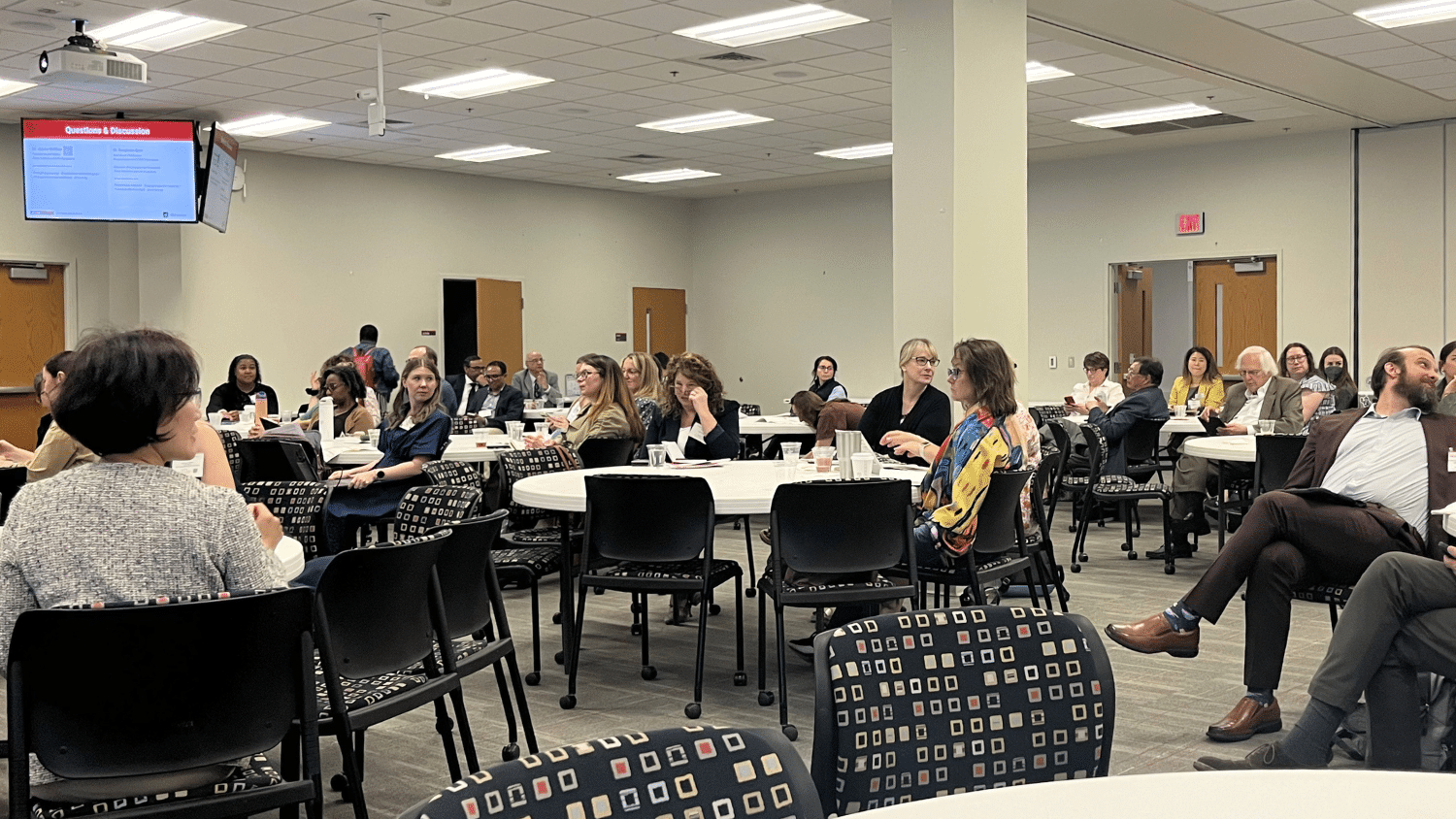
Helping to guide professionals through this uncharted territory, the Conference on AI in the Textile and Fashion Industries presented experts in AI usage while facilitating conversations and networking on April 1 and 2.
Hosted by the Fashion and Textile Business Excellence Cooperative at the The McKimmon Conference and Training Center at NC State, industry leaders from across the South gathered to discuss AI applications, concerns and innovations in textiles.
Innovating and regulating
The conference opened with a speech by Wilson College Dean David Hinks and a keynote by Rob Handfield, a professor in the Poole College of Management, exploring AI in supply chains.
The first session featured speakers exploring three different aspects of product development and manufacturing:
- Steven Hauser, a data scientist at Size Stream, explained his company’s applications of AI in body scanning technology in made-to-measure apparel, often helpful for large scale uniform production.
- Kerry Maguire King covered her research into producing electronic print designs using AI, including its limitations and her workarounds for producing usable designs with multiple tools.
- Ganesh Subramanian, CEO of Stylumia, a trend prediction company, spoke about how AI agents can be used to improve demand forecasting and bridge the gap between consumers and manufacturers.
Amber Issac of Artistic Milliners, a leading denim manufacturer, and Christopher Baughan of Peter Millar had a conversation about implementing AI into existing production systems. They said industry leaders are putting lots of effort into pinpointing how and where to use these technologies, and gave tips on how to tailor them to company needs.
Baughen said it is most important to first understand how these technologies are going to be used and regulated, and how employees and consumers will receive them.
When asked about job loss due to AI, Issac framed AI as a tool to assist human labor, rather than a replacement for it.
“At least initially, we see the most value in AI as an implementation in existing human workflows, and starting to eliminate manual repetitive and non-value adding work that humans are having to do, thereby freeing them up to be better at the job as they want to be doing,” Isaac said.
Many speakers emphasized the importance of good information being fed into AI. The output you receive, they said, is dependent on the quality and scale of the data you put in.
Creating a new customer experience
During the second session, speakers with expertise in large language models and chatbots discussed how these tools are being researched for professional applications:
- Jeanne McClure, a postdoctoral fellow at the Data Science and AI Academy, gave an overview of prompt engineering strategy and how to standardize the effective use of AI within a larger company.
- Gart Davis, co-founder of Spoonflower Practical, went over the practical applications of AI in digital textile e-commerce, such as indexing large collections or creating visuals.
- FTBEC Founder and Wilson College Professor Ellie Jin shared how Agent AI is being used to curate the consumer experience.
Jin’s presentation explored how the new technology of Agent AI has greater potential than generative AI. Jin said generative AI is a system that guides a human, while agent AI is an autonomous vehicle that independently reaches its destination.
The development of agent AI in fashion e-commerce, including brands like Shopify, Google and Amazon, means applications are aiming to match the intentions of the user more accurately.
“It doesn’t just recommend products,” Jin said. “It understands a customer’s lifestyle, assists with outfit selection and completely streamlines the checkout process.”
Agent AI is also being implemented in planning and development (trend analysis and design), in operations (managing inventory and building supply-chain resilience), and in marketing (personalized recommendations and optimizing promotional material), Jin said.
Other sessions focused on how AI can support supply chain sustainability, the legal and ethical concerns relevant to widespread AI use, and how AI can make advanced manufacturing more effective.
The presentation and panel sessions hosted on April 1 and 2 were bookended by professional, hands-on workshops that allowed participants to explore more applied solutions to problems in analytics, coding and manufacturing.
- Categories: