From Waste to Wardrobe: How Fashion Brands Are Embracing Upcycling
Read about upcycling, its creative application and how it’s being used on a wider scale to promote sustainability, based on research by recent Wilson College graduate Hyesim Seo.
This article was originally published by members of the Wilson College of Textiles’ Fashion Textile and Business Excellence Cooperative.
With growing concerns for sustainability, upcycling is drawing the attention of leaders in the textile and apparel industry seeking innovative circular solutions to reduce textile waste and mitigate its environmental impact (Aus et al., 2021). The practice combines sustainability with creativity, giving new life and added value to materials that might otherwise be discarded.
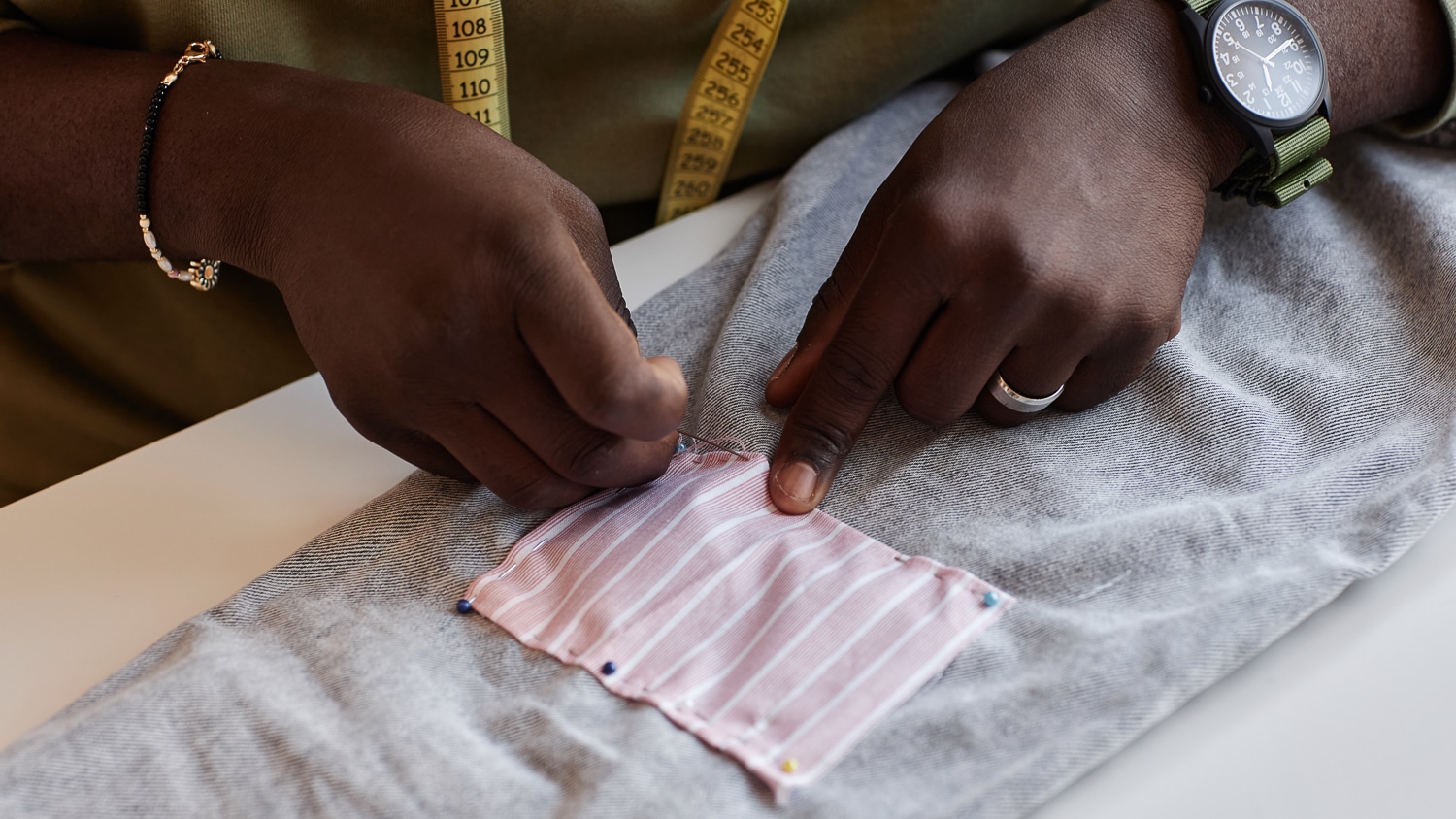
Upcycling can take many different forms. Generally, it refers to the process of transforming used or discarded products and materials through repurposing, repairing, upgrading and remanufacturing in a way that increases their value (Singh, 2019). For instance, used glass bottles can be upcycled into decorative vases, or discarded denim jeans can be transformed into unique patchwork apparel. It is a recycling approach in which waste materials are developed into products of greater value or quality than the original product, in contrast to downcycling, which produces recycled items of lower value (Kamble & Behera, 2021).
Upcycling as a creative practice
In fashion, upcycling is commonly understood as a design-based approach (Aus et al., 2021). In contrast to other textile recycling processes that decompose fabrics into raw materials, upcycling involves repurposing existing fabrics and products through creative design (Cassidy & Han, 2017).
The upcycling design process can present interesting challenges compared to the regular design process because it relies on the availability of textile waste and leftovers, which can vary in type, shape and quantity (Aus et al., 2021). This variability makes fashion products difficult to produce on a mass scale (Cassidy & Han, 2013) and results in products that are inherently unique.
Various design techniques, such as patching, cutting, adding and material mixing, are employed in the upcycling design process to develop new designs from limited and inconsistent materials (Seo, 2025). The doctoral dissertation of Hyesim Seo, who recently graduated with their doctoral degree in textile technology management, includes more details on the fashion upcycling process and upcycled clothing.
Upcycling in the fashion industry
From mainstream labels to luxury designers, more and more fashion brands are embracing upcycling by offering upcycled products. Fashion brands’ adoption of upcycled products and marketing methods can be categorized into three types.
First, some brands focus their central mission on producing upcycled fashion. An example is Freitag, a brand well known for using upcycled truck tarps to create bags and accessories.
The second category consists of already established brands that feature upcycled product lines, like Urban Outfitters’ Urban Renewal.
The third category is brands that release limited-time collections of upcycled items. For instance, Stella McCartney showcased upcycled items made with surplus materials in their Summer 2023 collection. Table 1 shows these three approaches and brands.
Table 1. Brands dedicated to upcycled fashion
| Brand | Country | Year |
|---|---|---|
| Freitag | Switzerland | 1993 |
| RE;CODE | South Korea | 2012 |
| E. L. V. Denim | UK | 2018 |
| 1/OFF Paris | Netherlands | 2019 |
| Bettter | UK | 2020 |
| Revibe | France | 2021 |
Table 2. Upcycled product lines within a brand
| Brand | Country | Year |
|---|---|---|
| Urban Outfitters – Urban Renewal | US | 1983 |
| RE/DONE x Levi’s | US | 2014 |
| Patagonia -ReCrafted | US | 2019 |
| Miu Miu Upcycled | Italy | 2020 |
| Tommy Remixed | US | 2021 |
| Coachtopia | US | 2023 |
Table 3. Limited-time collections for upcycled products
| Brand | Country | Year |
|---|---|---|
| Charles & Keith | Singapore | 2020 |
| Diesel | Italy | 2020 |
| Ganni | Denmark | 2021 |
| Louis Vuitton | France | 2021 |
| Madewell | US | 2021 |
| ThredUp | US | 2022 |
| Nike | US | 2023 |
| The RealReal | US | 2021 |
| Adidas | Germany | 2021 |
| Stella McCartney | UK | 2023 |
Note: The year indicates either the establishment year of the brand or product line, or the launch year of a specific upcycled collection.
Upcycling offers a promising way to reduce waste and add value in fashion, but its true impact depends on how it is implemented. FTBEC researchers say upcycling should aim to create real improvements in sustainability, rather than serve as a marketing tool to showcase a brand’s eco-friendly image.
The FTBEC recommends that brands adopting upcycling should consider not only the potential benefits of offering upcycled products but also whether their approach is truly authentic and makes meaningful change. When done thoughtfully, upcycling has the potential to transform the fashion industry into a more responsible and innovative space.
References
Aus, R., Moora, H., Vihma, M., Unt, R., Kiisa, M., & Kapur, S. (2021). Designing for circular fashion: Integrating upcycling into conventional garment manufacturing processes. Fashion and Textiles, 8(34), 1-18. https://doi.org/10.1186/s40691-021-00262-9
Kamble, Z., & Behera, B. K. (2021). Upcycling textile wastes: Challenges and innovations. Textile Progress, 53(2), 65-122. https://doi.org/10.1080/00405167.2021.1986965
Seo, H. (2025). Green or unique? How design typicality and material domain distance influence purchase intentions for upcycled clothing [Unpublished doctoral dissertation]. North Carolina State University.
Singh, J., Sung, K., Cooper, T., West, K., & Mont, O. (2019). Challenges and opportunities for scaling up upcycling businesses – The case of textile and wood upcycling businesses in the UK. Resources, Conservation & Recycling, 150, 104439. https://doi.org/10.1016/j.resconrec.2019.104439
- Categories: